2025 was the year the luxury market split in two. At the top — Hermès, Richemont, Cartier — resilience and growth. Below — Gucci, Saint Laurent, most of aspirational luxury — sustained decline. The divide is not cyclical. It is structural. And understanding it is the most important strategic question in luxury right now.
There is a concept in economics called the K-shaped recovery: a moment when different parts of the same market diverge so sharply that they appear to be operating in entirely different conditions. One group recovers and grows. The other continues to decline. The shape of the letter K captures it — one arm rising, one falling, from the same starting point.
The global luxury market in 2025 is K-shaped. And the divergence is wider, more persistent, and more structurally rooted than most industry commentary has acknowledged.
01 The numbers that define the divide.
The headline figures from 2025 tell the story directly. Hermès generated €16.0 billion in revenue, up 5.5% at current exchange rates and 8.9% at constant currency, with an operating margin of 41% — one of the highest in any consumer sector globally2. Richemont delivered €22.4bn in its financial year to 31 March 2026, up 4.7%, driven by its jewellery maisons3. Meanwhile, LVMH reported 2025 revenues of €80.8 billion, down 1% organically, with operating margin compressing from 23% to approximately 22%. And Kering — owner of Gucci, Saint Laurent, and Bottega Veneta — saw 2025 sales fall approximately 13% on a reported basis, with recurring operating margin collapsing to around 11%, and recurring net income halving to €0.5 billion9.
Hermès
+5.5% current / +8.9% constant — Revenue growth 2025 · 41% operating margin · Free cash flow > €1B capex
Kering / Gucci
−13% — Kering 2025 reported sales decline · Operating margin ~11% · Net income halved to €0.5B
Richemont
+4.7% — FY to 31 March 2026, driven by jewellery maisons · Americas +16%, Japan +25% · €8.3B net cash
LVMH
−1% — Organic decline 2025 · Margin compression to ~22%
IMD's Luxury Trends 2026 analysis names this directly: "These results confirm a K-shaped luxury world: resilience at the top end, fragility in aspirational tiers, and widening gaps between brands that adapted early and those still relying on old playbooks."1
02 What separates the two arms.
The divergence is not random. It follows a consistent logic: brands positioned at the ultra-high-net-worth end of the market, with genuine scarcity, pricing discipline, and vertical integration, have remained resilient. Brands whose growth during the post-COVID luxury boom relied on aspirational consumers — those spending on luxury occasionally, driven by aspiration rather than deep financial capacity — have suffered most as that consumer cohort pulled back.
The K-shaped luxury world of 2026 is defined by ultra-high-net-worth individuals continuing to drive value, even as aspirational consumers retract under sustained inflation and a perceived deterioration in the luxury value proposition.— TCL Analysis
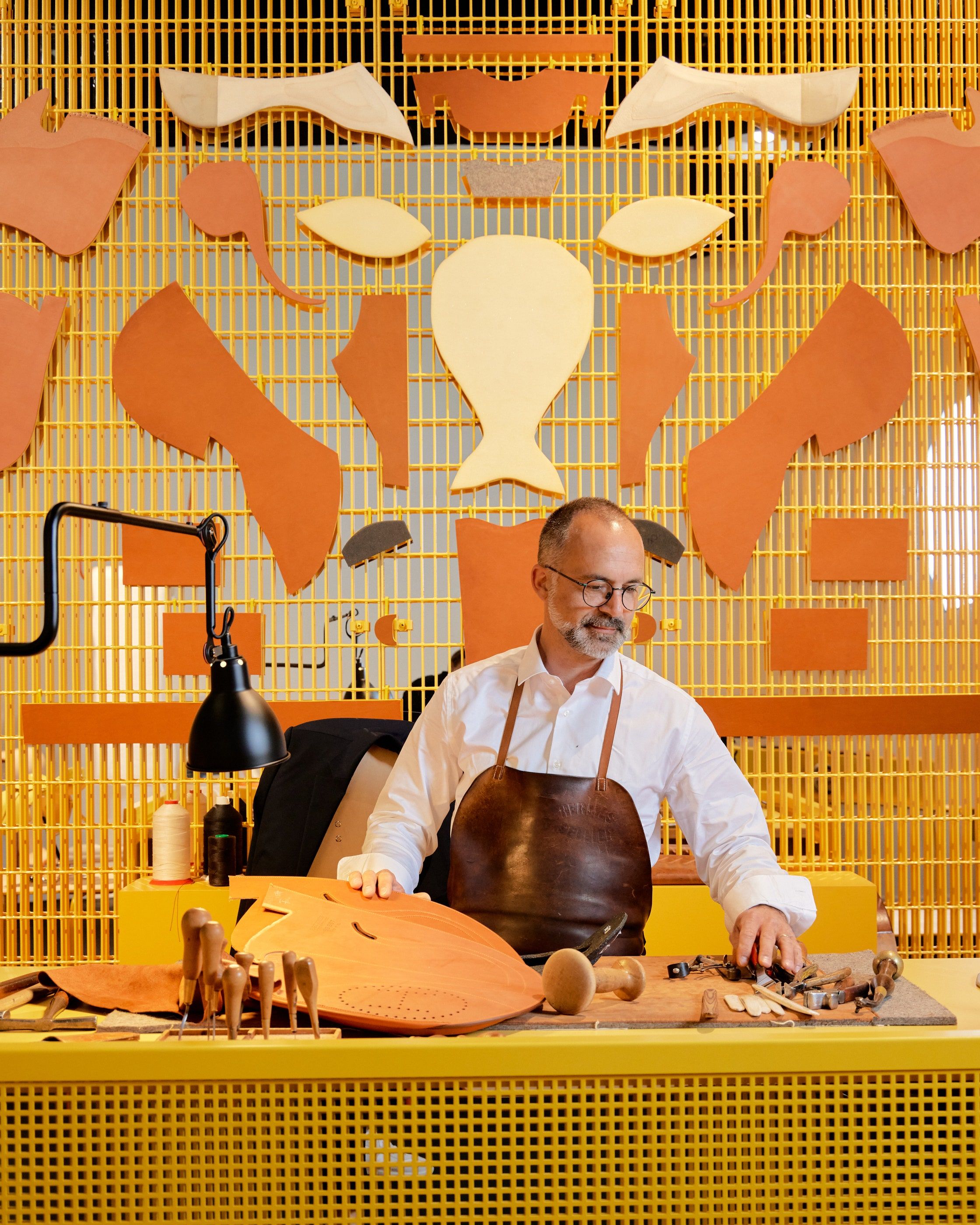
Hermès is the clearest illustration. Its allocation-based distribution for the Birkin and Kelly bags, its vertical integration across leather, its refusal to expand distribution, and its extraordinary pricing discipline have created a consumer base that is, almost by definition, insulated from economic pressure. The brand's customer is not choosing between a Birkin and a holiday. The brand's customer is choosing between a Birkin and another Birkin.
Kering's Gucci, by contrast, had expanded aggressively during the Alessandro Michele era — building a consumer base with broad demographic reach, significant aspiration, and significant price sensitivity. When the aspiration economy stalled, that consumer base retracted. The revenue decline was not a failure of creativity alone. It was the consequence of a distribution and positioning strategy that had, over time, moved the brand toward the middle of the market rather than the top of it.
03 The structural shifts underneath the numbers.
Two structural changes are amplifying the K-shape and making it more persistent than a typical cyclical downturn.
The first is the concentration of luxury spending. McKinsey's State of Fashion 2026 analysis documents that the economic profit of the industry nearly tripled between 2019 and 2024, yet remains concentrated in the "Super Winners" — LVMH, Hermès, Richemont, and Kering — who collectively represent the majority of sector profit4. Within those conglomerates, concentration is even more extreme: within LVMH, Louis Vuitton and Dior account for the overwhelming majority of economic profit; within Kering, Gucci was responsible for approximately half of revenue and two-thirds of profit before its decline.
The second structural shift is the movement from goods to experiences among high-net-worth consumers. Julius Baer's 2025 Lifestyle Survey documented that HNWI increased spending on hotels and fine dining6 while pulling back from traditional luxury goods. This is not a temporary preference shift — it reflects a deeper recalibration of what luxury means to the people with the most capacity to spend on it. Brands positioned as goods companies rather than experience companies face a structural headwind that no creative director change can immediately resolve.
04 What this means for brand strategy.
The K-shaped market has a direct and uncomfortable implication for brand strategy: position determines destiny more than execution does, at least in the short to medium term. A brand with Hermès's positioning will weather almost any macroeconomic environment. A brand with Gucci's positioning — however brilliantly managed — will find the headwinds severe.
This does not mean that aspirational luxury is finished. The Bain / Altagamma 2026 luxury market projections anticipate sector growth of 3–5% in 20267, supported by Chinese recovery and renewed momentum in the US. But the distribution of that growth will remain uneven. Brands that have spent the 2024–2025 period repositioning toward ultra-high-net-worth consumers, narrowing distribution, and rebuilding scarcity perception — Burberry under Daniel Lee, potentially Gucci under Demna — are building toward the rising arm of the K. Those that have not made that repositioning will find the recovery slower than the headlines suggest.
05 The shape after the shape.
Nine months after this piece was published, the two arms of the K had begun to converge — and the market that prices them had already reversed its verdict.
Hermès decelerated sharply. First-half 2026 revenue reached €8,163 million, up 1.6% at current exchange rates and 6.1% at constant rates10, against 7.1% and 8.1% in the same period a year earlier. The rising arm is still rising, but on a reported basis at under a quarter of its previous slope.
The equity market moved first, and further. Between the close of 2024 and 12 August 2026, Hermès fell 30.7% and LVMH 26.8%, while Kering — the falling arm of this article — rose 14.9%. In calendar 2025 alone Kering gained 26.3% against a decline of 8.2% at Hermès. Hermès now trades 43.3% below its peak close of €2,827.3611, set on 14 February 2025.
This is not a refutation of the K-shape. It is a demonstration of what a K-shape describes: operating performance, not valuation. Position determined revenue; expectations determined price. Kering was re-rated on a change of management, not on a change of results — its operational recovery remains unproven. Hermès was de-rated because a business growing at 1.6% cannot carry a multiple built for one growing at 9%.
The lesson is narrower than it first appeared. Position determines destiny in the profit-and-loss account. It does not determine what investors will pay for that account, and the two can move in opposite directions for years.
See the underlying series: Luxury Share Prices — Euronext Paris, August 2024 – August 2026.
The K-shaped luxury market is not a crisis. It is a clarification. It is the market revealing, with unusual precision, which brands have genuinely earned their position at the top of luxury — and which had merely borrowed it during the exceptional conditions of the post-COVID boom.
See the dataHermès vs GucciOpen the dashboardSources & Further Reading
- 01 IMD. (2026, April). Luxury Trends 2026: Creating Relevance — K-shaped luxury market framing, LVMH/Kering/Richemont comparative data.
- 02 Hermès. (2026). Full Year 2025 Results.
- 03 Richemont. (2026). Full-year results, financial year to 31 March 2026 — €22.4bn revenue, up 4.7%, driven by jewellery maisons; Americas +16%, Japan +25%, €8.3B net cash.
- 04 McKinsey & Company / Business of Fashion. (2026). The State of Fashion 2026: When the rules change. — "Super Winners" economic-profit concentration (industry economic profit nearly tripled 2019–2024), K-shaped divergence.
- 05 Glossy / Modern Retail. (2025, December). The K-shaped economy is forcing luxury brands to pick a side. — Mytheresa "big-spending wardrobe-building customers", Placer.ai traffic data.
- 06 Julius Baer. (2025). Lifestyle Survey. — HNWI spending shift from goods to experiential luxury.
- 07 Bain & Company / Fondazione Altagamma. (2026, Spring). Luxury Goods Worldwide Market Study — Spring 2026 Update. — 3–5% global growth forecast 2026, total luxury market flat 2025 at ~€1.44T, personal luxury goods €358B.
- 08 Han, Y. J., Nunes, J. C., & Drèze, X. (2010). Signaling status with luxury goods. Journal of Marketing, 74(4), 15–30. — theoretical framework for patricians vs. parvenus divergence.
- 09 Kering. (2026). Full Year 2025 Results.
- 10 Hermès International. (2026, July 29). First-half 2026 results. — H1 2026 revenue €8,163M, +1.6% at current rates / +6.1% at constant rates; H1 2025 +7.1% / +8.1%.
- 11 Euronext Paris — historical price exports, FR0000052292 (Hermès), FR0000121014 (LVMH), FR0000121485 (Kering), 14 Aug 2024 – 12 Aug 2026. Closing prices, euros; index and drawdown calculations derived from them.
- 12 Lannes, B., et al. — The 2025 Chinese Personal Luxury Goods Market
- 13 IMD Luxury Trends 2026: Creating Relevance
- 14 D'Arpizio, C., Levato, F., Steiner, A., Babbini, G., de Montgolfier, J., & Glaser, H. — Bain-Altagamma Luxury Goods Worldwide Market Study — Spring 2026 Update
Cite this insight
The Codes of Luxury. (2026, May 27). The K-Shaped luxury market: Why Hermès grows while Gucci falls. https://codeofluxury.cloakify.pro/insights/the-k-shaped-luxury-market-why-hermes-grows-while-gucci-falls