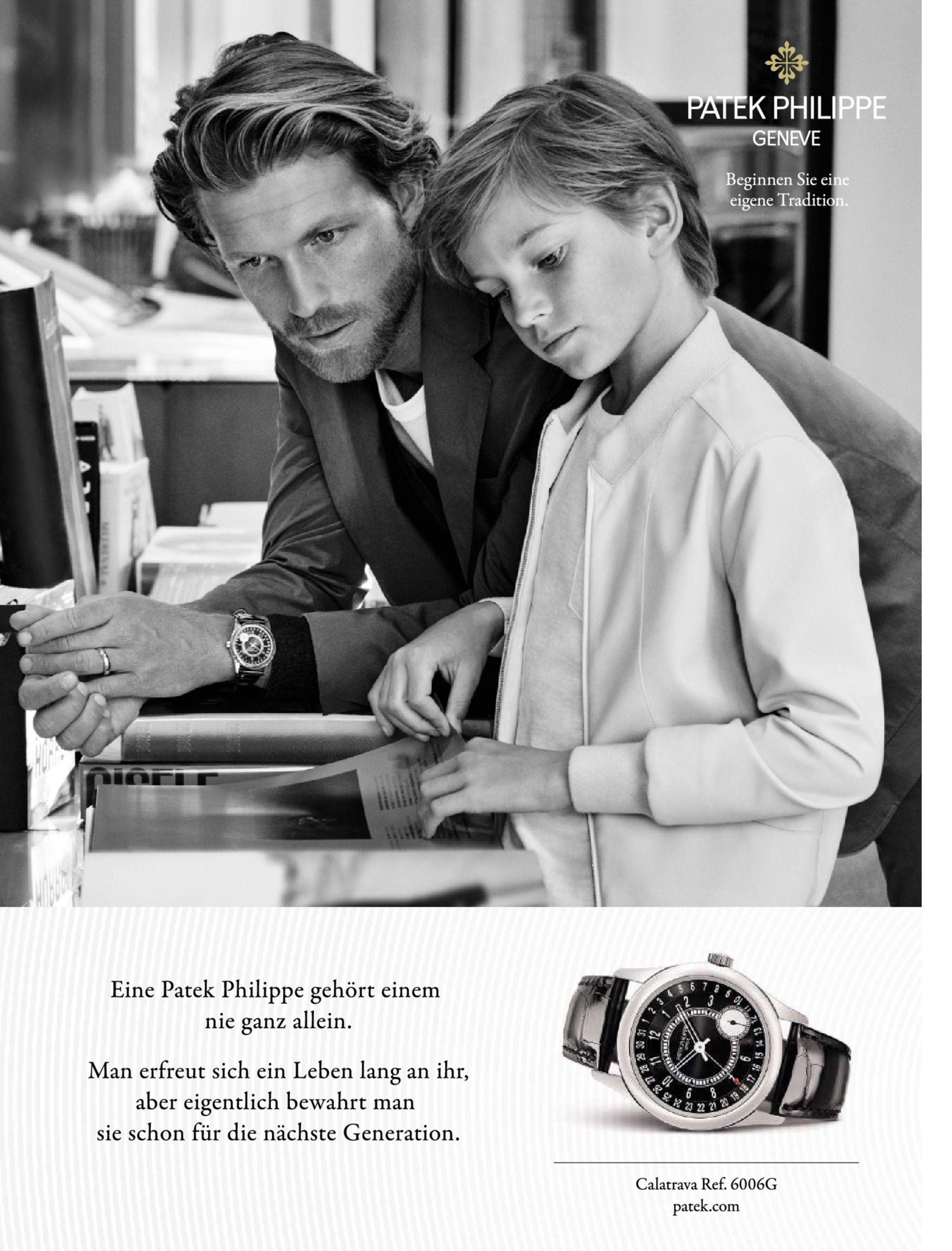
In 1996 Patek Philippe moved its advertising to the London agency Leagas Delaney. Early the following year the campaign ran a line written by Tim Delaney around the concept begin your own tradition: “You never actually own a Patek Philippe. You merely look after it for the next generation.”
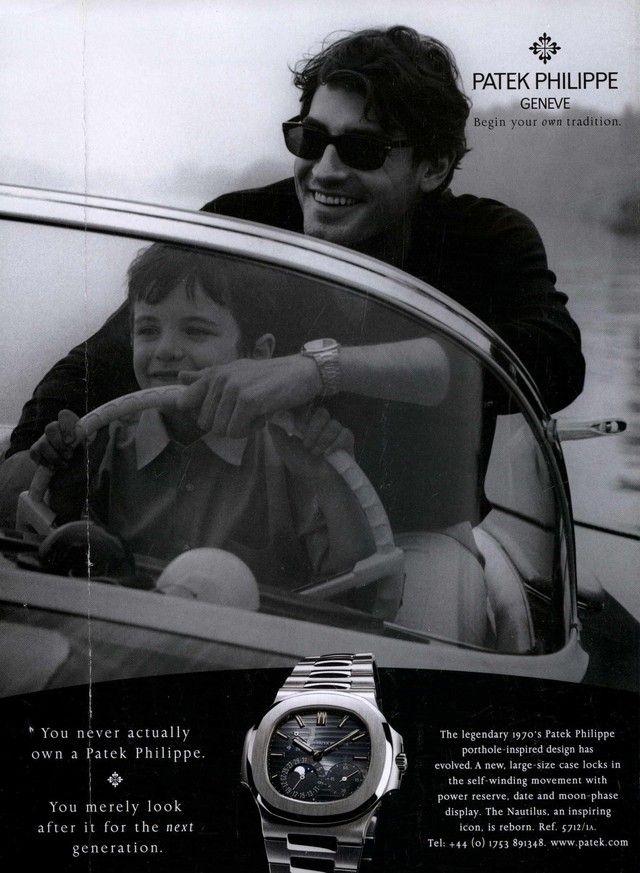
The first advertisements contained no watch. They showed a father and a son, a mother and a daughter, in soft light — quiet domestic scenes, photographed like editorial rather than product. A watch company had bought pages in which to not show a watch.
01 What the sentence commits you to.
Read as advertising, the line is a piece of romance about inheritance. Read as a corporate undertaking, it is considerably more demanding. Three things have to be true for it to survive contact with reality.
- FIRST
The object must outlast you
Which requires that every movement the company has ever made remains serviceable, indefinitely, by the company itself. A promise of inheritance is a promise of perpetual repair.
- SECOND
It must stay worth inheriting
An heirloom that has become common is a possession. Volume growth is not simply off-strategy here; it directly falsifies the claim in the advertisement.
- THIRD
The company must still be there
A generational guarantee from a business that might be sold, restructured or wound down is worth nothing. Independence stops being a preference and becomes an obligation.
Most luxury advertising makes claims the operating business is never asked to underwrite. This one wrote a cheque against production volume, service capacity and ownership structure simultaneously — and then ran for three decades, which meant the cheque kept being presented.
02 Thirty years of not growing.
1996–97
LEAGAS DELANEY APPOINTED; THE LINE FIRST RUNS IN EARLY 1997 — STILL RUNNING TODAY
Leagas Delaney
~70,000
WATCHES A YEAR — A BAND THE COMPANY HAS HELD FOR DECADES
Industry estimates; Patek Philippe is private and does not publish
CHF 2.5BN
ESTIMATED 2025 REVENUE, UP 9% — GROWTH FROM PRICE AND MIX, NOT VOLUME
Industry estimates, 2025
37% → ~50%
SHARE OF THE SWISS WATCH INDUSTRY BY VALUE HELD BY ROLEX, PATEK, AUDEMARS PIGUET AND RICHARD MILLE, 2019 TO 2025
Industry analysis
Patek Philippe is privately held by the Stern family and publishes nothing, so every figure here is an estimate. But the estimates agree on the shape: output has sat in a narrow band for decades — roughly 60,000 to 70,000 watches a year — while revenue has climbed to around CHF 2.5 billion, up 9% in 2025.
That combination is the whole strategy in two numbers. The company grew value without growing volume. Every euro of additional revenue came from pricing, complication and mix rather than from making more watches — which is the only growth model compatible with a promise of inheritance.
It has also been extremely profitable to be one of the few houses that could credibly say this. Rolex, Patek Philippe, Audemars Piguet and Richard Mille together now account for roughly half the Swiss watch industry by value, against about 37% in 2019. The consolidation of the category into a handful of names has rewarded precisely the brands that declined to expand into it.
03 The secondary market prices a sliver.
Patek Philippe is routinely cited as the strongest store of value in watchmaking, on the evidence of what its references fetch at auction and on resale platforms. That evidence is real, and it describes a smaller part of the business than the citation implies.
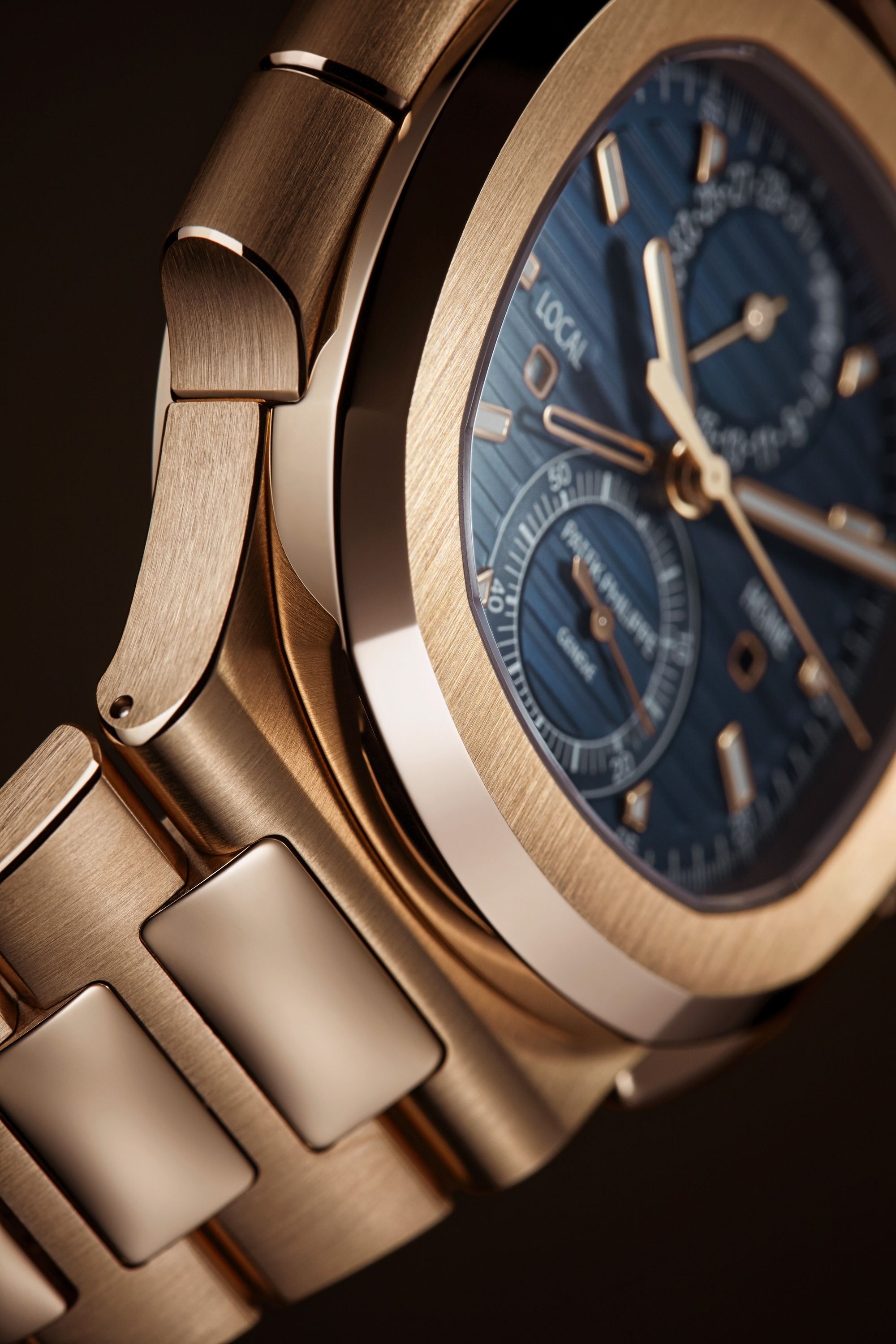
More than 60% of Patek's annual output consists of complicated or high-complication references that are not frequently traded. Price discovery therefore concentrates into a narrow subset of steel and low-complication watches — the Nautilus and Aquanaut families above all. The famous resale premium is measured on the minority of what the company makes.
The secondary market is the loudest evidence for the inheritance claim and the weakest. A watch that trades often is a watch that is not being handed down. The pieces that prove the advertisement are precisely the ones no index can see.— TCL Analysis
This is worth stating plainly because the industry has spent a decade treating resale performance as the definitive measure of brand health. For a house whose central promise is that the object does not change hands, high trading volume would be a signal of failure, not success. Patek's illiquidity in most of its range is the claim working.
04 Why nobody has copied it.
The line has been admired for thirty years and imitated almost not at all, which is unusual for a piece of advertising this famous. The reason is not that other houses lack the copywriters. It is that almost none of them could survive the commitment.
A listed group cannot promise never to grow volume. A brand owned by a conglomerate cannot promise institutional permanence on its own authority. A house that has already expanded distribution cannot claim its object is rare. The sentence is only available to a company that is independent, family-controlled, volume-disciplined and prepared to service everything it has ever built.
Which reframes what the campaign actually was. Leagas Delaney did not invent a brand position in 1996. They found the one sentence that only this company was entitled to say, and Patek Philippe then spent three decades earning the right to keep saying it.
05 What Patek teaches about writing a promise you have to keep.
- Lesson 01
The best brand line is an operating constraint
A claim that costs the business nothing communicates nothing. This one governs production volume, service policy and ownership structure, which is why it has been believed for thirty years.
- Lesson 02
Grow value, not units
Output has held near 70,000 a year for decades while revenue reached CHF 2.5 billion. Price and complication did the work that distribution does elsewhere.
- Lesson 03
Resale data measures the wrong watches
Over 60% of output rarely trades. Any index of Patek's value is built on the steel minority, and the pieces that best vindicate the brand are invisible to it.
- Lesson 04
Some positions are not available to you
Independence, family control and volume discipline are the price of entry to this sentence. A brand without all three can write it, but cannot mean it — and the market can tell.
The campaign will pass thirty years in 2027. In an industry that changes creative direction every three seasons and repositions every five, a single sentence has been running unaltered since before most of its current customers were born.
That longevity is usually cited as proof of the line's quality. It is better read as proof of the company's. The advertisement has not needed rewriting because the business behind it has not needed correcting — and in luxury, that is the rarer achievement by some distance.
Sources & Further Reading
- 01 Leagas Delaney. Patek Philippe — Generations. Agency case study.
- 02 SJX Watches. (2025, August). Insight: the evolution of Patek Philippe marketing since 1839.
- 03 Forbes. (2016, December 9). Patek Philippe celebrates 20 years of its iconic advertising campaign.
- 04 Worldtempus. (2025). Patek Philippe in 2025 and in numbers.
- 05 Morgan Stanley / LuxeConsult. (2025). Swiss watch industry report — brand share of industry value.
- 06 Chrono24. (2025). Secondary watch market report H1 2025.
- 07 Han, Y. J., Nunes, J. C., & Drèze, X. (2010). Signaling status with luxury goods: The role of brand prominence. Journal of Marketing, 74(4), 15–30.
- 08 Beverland, M. B. (2005). Crafting brand authenticity: The case of luxury wines. Journal of Management Studies, 42(5), 1003–1029.
Cite this case study
The Codes of Luxury. (2026, October 18). Patek Philippe: "You Never Actually own a Patek Philippe" (Case N°22). https://codeofluxury.cloakify.pro/case-studies/patek-philippe-you-never-actually-own-a-patek-philippe