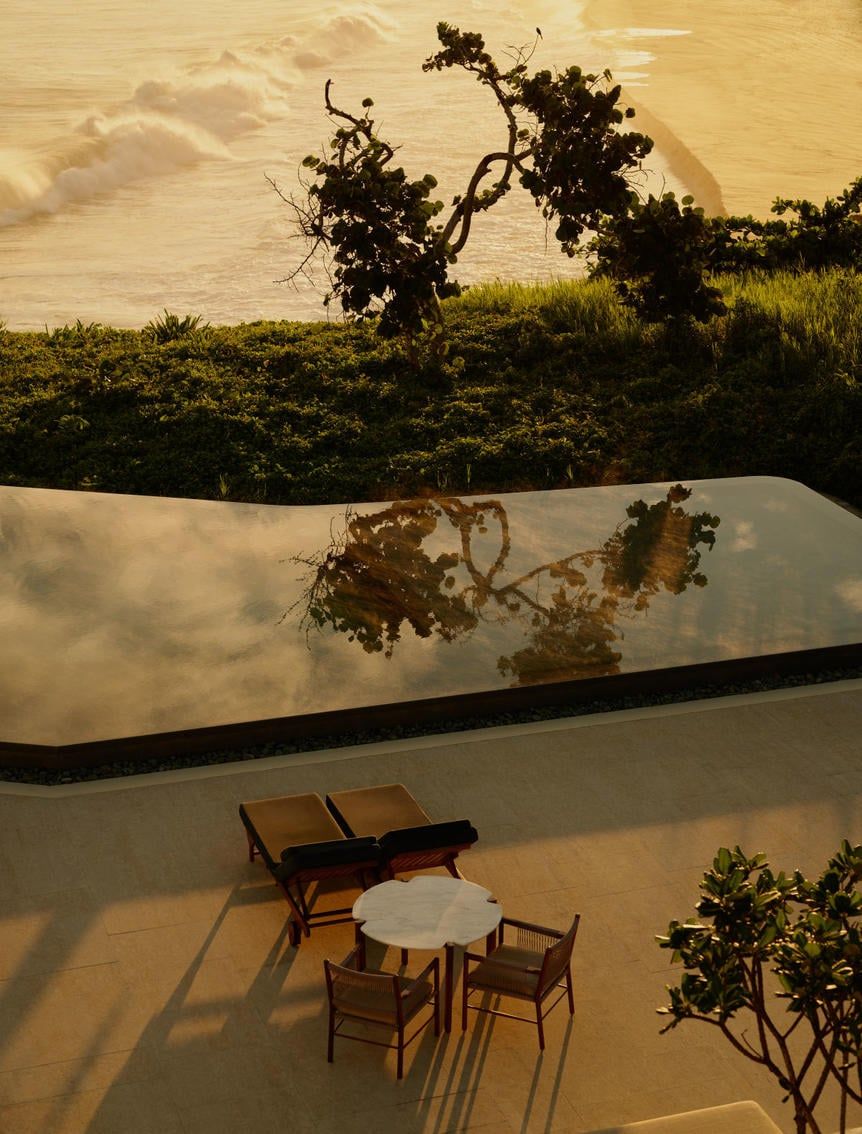
In January 1988 the Indonesian hotelier Adrian Zecha opened a forty-room resort on a headland in Phuket. It had cost about $4 million and it charged, by contemporary accounts, roughly five times the local rate. He had set out to build a holiday house and ended up building a category.
Amanpuri was the first of what is now thirty-six properties in twenty countries, and the operating rule established at the outset has never been formally revised: the company does not advertise. Not sparingly. At all.
01 What was built, and how.
1988
AMANPURI OPENS IN PHUKET — $4 MILLION, FORTY ROOMS, ABOUT FIVE TIMES THE LOCAL RATE
Aman / press accounts
~50%
SHARE OF BUSINESS ESTIMATED TO COME FROM REPEAT GUESTS
Industry estimates
30–50
ROOMS PER PROPERTY BY DESIGN — SMALL ENOUGH FOR STAFF TO KNOW EVERY GUEST
Aman
36 / 20
PROPERTIES ACROSS TWENTY COUNTRIES, WITH A PIPELINE OF A DOZEN MORE
Aman, 2026
The construction is unusually coherent. Properties are held at thirty to fifty rooms deliberately, on the reasoning that staff must be able to know every guest and the place must feel closer to a private house than a hotel. Sites are remote, or were. Architecture is site-specific rather than branded. There is no logo on the towels in any meaningful sense, and there was never a campaign explaining any of it.
What replaced advertising was arithmetic. If a property has forty rooms and half of its guests return, you do not need reach. You need the right two thousand people to know, and for them to tell each other.

02 The junkie economy.
The industry's term for Aman's core customer is not flattering and is used affectionately: Aman junkies. They are estimated to supply around half the group's business, and the defining behaviour is collection — guests who have stayed at twenty or more properties, working through the portfolio the way others work through a wine list.
This is a remarkable asset and a very particular one, because it depends on two conditions holding simultaneously.
- CONDITION 01
Enough properties to collect
A set of four is not a collection. The behaviour requires a portfolio wide enough that completing it is an ambition — which means growth is not optional, it is what feeds the loyalty.
- CONDITION 02
Few enough that it stays finite
A set of two hundred is not collectable either. Past some number the project becomes impossible, the scarcity dissolves, and the guest becomes a customer of a chain.
Aman's growth problem is therefore not the usual one. It is not whether demand exists — it plainly does. It is that the group's most valuable customer behaviour lives inside a window, and the window has an upper edge that nobody can locate in advance.
03 What changed in 2014.
Aman is privately held and does not publish financial statements. Every figure that follows is an outside estimate or a statement made in interview, and should be read as such.
Vladislav Doronin acquired Aman in 2014 and is its chairman, chief executive and owner. Valuation estimates for the group have been reported at around $3 billion on an enterprise basis and, by Doronin himself, at approximately $4.5 billion.
Under his ownership three things have moved, and all three point away from the founding construction.
- Shift 01 · From remote to urban
The pipeline is heavily weighted to cities — Dubai, Bangkok, Mexico City, Singapore, Beverly Hills, Miami Beach — pursuing year-round demand rather than seasonal resort occupancy. Aman Nai Lert Bangkok opened in April 2025.
- Shift 02 · From hospitality to real estate
Branded residences are reported to account for roughly 40% of the group's valuation. The business increasingly sells apartments with a name on them, not only nights in a room.
- Shift 03 · From one brand to two
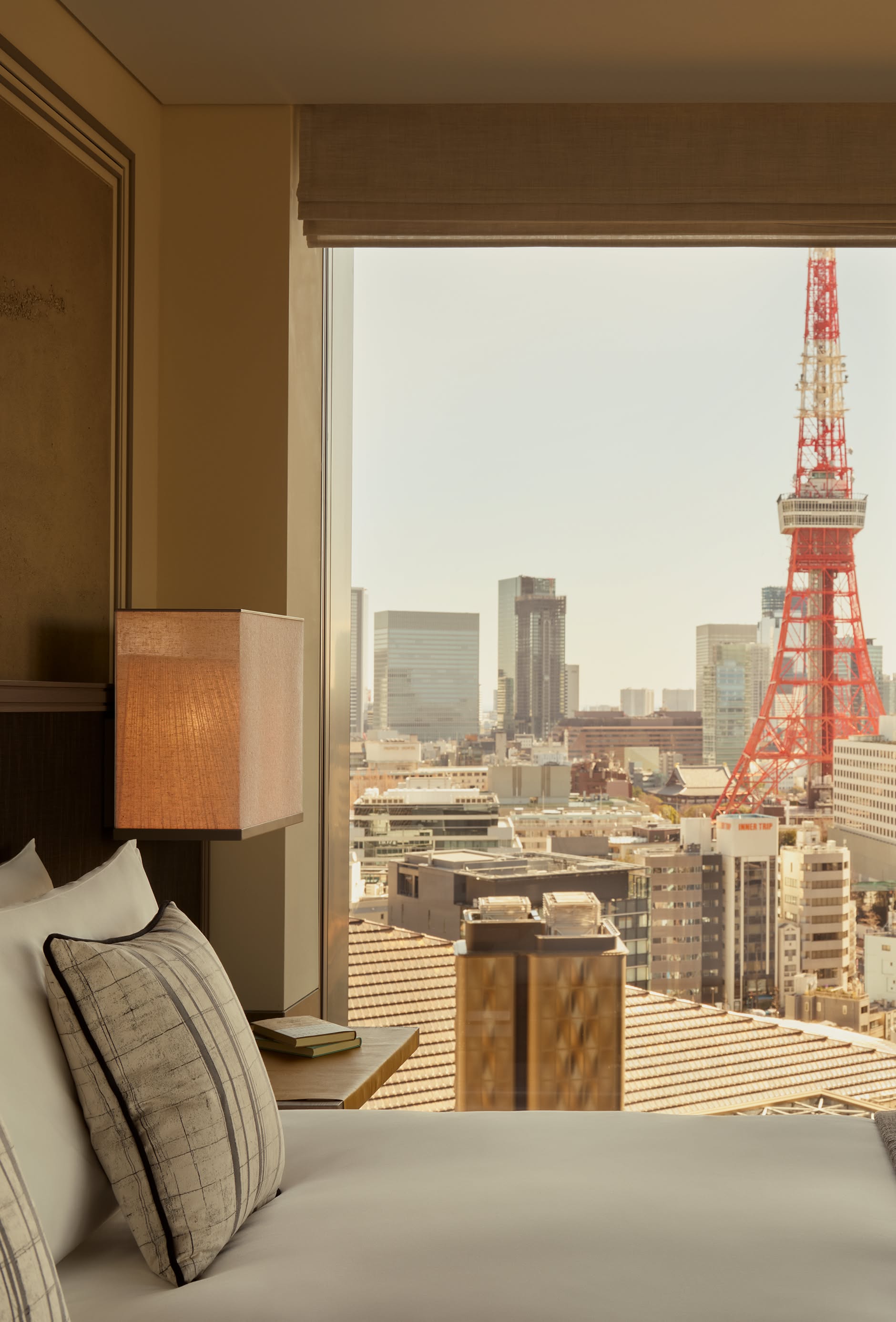
Janu — from a word meaning soul — opened in Tokyo in March 2024 after two years of development, with a reported dozen more in progress across Dubai, Portugal, Saudi Arabia, South Korea and Turkey.
Read together, these are the moves of an owner who needs the asset to compound. Branded residences convert brand equity into capital immediately rather than a night at a time. Cities smooth the seasonality that resorts cannot avoid. And a second brand multiplies the number of doors without multiplying the number of Amans.
04 Janu, and the logic of a second brand.
Janu is easy to dismiss as line extension and is better understood as a defensive structure. If urban, social, higher-density hospitality is where the growth is, an owner has two options. Open Amans in cities, which erodes the remoteness and the room count that define the original. Or build a second brand to absorb that demand and leave the first one alone.
L'Oréal grew Aesop by moving an unchanged brand to new geography rather than adding density in existing markets. Aman is attempting the same protection by a different route — adding a second name instead of a new map. Both are answers to the same question: how do you grow a business whose value is scarcity.— TCL Analysis
The risk is specific and worth naming. Aman's loyalty runs on completeness — the sense that the portfolio is a finite set worth finishing. A sister brand that shares the parent's design language and is openly aimed at the same loyalists blurs the edge of that set. If a Janu counts toward the collection, the collection has just become much harder to complete. If it does not, the group has built a brand its best customers have no reason to visit.
That ambiguity is unresolved, and it is the most interesting open question in luxury hospitality at the moment.
05 What Aman teaches.
- Lesson 01
Not advertising is only affordable at the right scale
Forty rooms and 50% repeat business means the addressable audience is small enough for word of mouth to reach all of it. The refusal is a consequence of the room count, not a substitute for marketing.
- Lesson 02
Collection loyalty needs a finite set
The behaviour that produces half the revenue requires the portfolio to be large enough to be worth completing and small enough to be completable. Growth feeds it and then, past some point, kills it.
- Lesson 03
Branded residences change what the business is
At roughly 40% of valuation, real estate is no longer an adjacency. A hospitality brand that monetises through property is being valued on a different logic from the one that made it desirable.
- Lesson 04
A second brand protects the first only if the boundary is clear
Janu can shield Aman from urban dilution, but only if guests understand which set they are collecting. Ambiguity between the two would spread the problem rather than contain it.
None of this is a prediction of failure. Aman under its current ownership has opened in Tokyo, New York, Bangkok and Venice, launched a second brand, and built a pipeline across five continents while remaining, by any measure of desirability, at the top of its category. The refusal to advertise has survived a decade of aggressive expansion, which is itself remarkable.
But the phrase anti-brand brand described a company of a certain size, in certain places, doing a certain number of things. Thirty-eight years on it has thirty-six properties, twelve more coming, a sister brand with a dozen of its own, and forty per cent of its value in apartments. The advertising budget is still zero. Everything else about the sentence is now a question.
Sources & Further Reading
- 01 Aman. Leadership team and property portfolio. Brand site.
- 02 Aman. (2023). Aman launches Janu. Brand announcement.
- 03 Robb Report. (2023). Aman announces the launch of a new sister brand.
- 04 Travel Weekly. (2024). Aman wants loyalists hooked on new Janu brand.
- 05 Spear's. What are Vladislav Doronin's plans for Aman Resorts?
- 06 Martin Roll. Aman — the unbranded Asian luxury resort brand.
- 07 One Mile at a Time. Aman Resorts: a remarkable hospitality brand that has evolved over time.
- 08 Peng, C., Bijmolt, T. H. A., Völckner, F., & Zhao, H. (2023). A meta-analysis of brand extension success. Journal of Marketing, 87(5).
- 09 Albrecht, C.-M., Backhaus, C., Gurzki, H., & Woisetschläger, D. M. (2013). Drivers of brand extension success: What really matters for luxury brands. Psychology & Marketing, 30(8), 647–659.
Cite this case study
The Codes of Luxury. (2026, November 18). Aman Resorts: The Anti-Brand brand (Case N°25). https://codeofluxury.cloakify.pro/case-studies/aman-resorts-the-anti-brand-brand