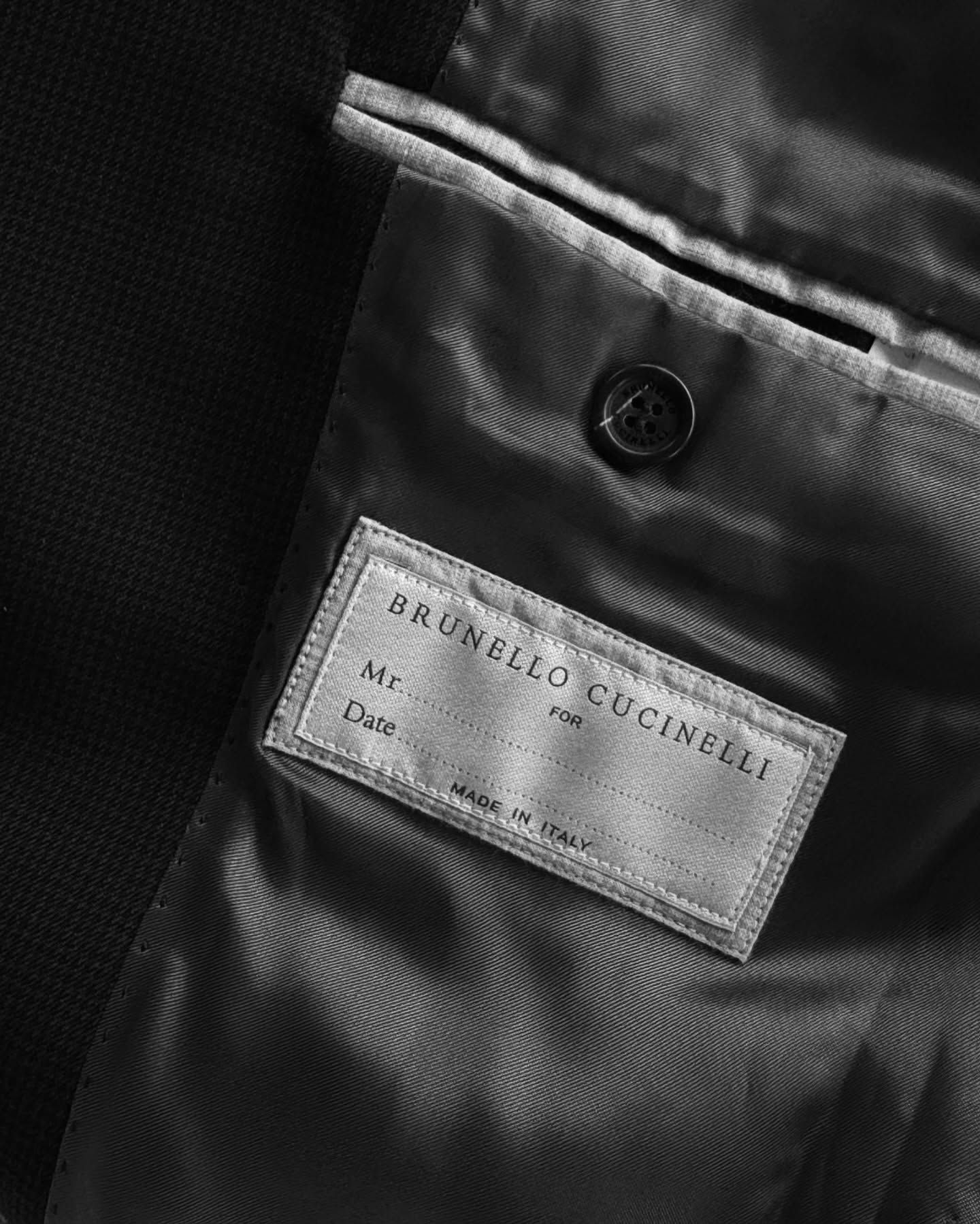
The move from logomania to stealth wealth is not a trend cycle. It is a structural shift in how status is communicated — rooted in consumer psychology, cultural capital, and a decades-long academic argument about what signals really mean.
In 2023, "quiet luxury" became one of the most searched fashion terms on the internet. Google searches surged by more than 600% year-on-year. Loro Piana saw a spike in global demand following the finale of Succession. Brunello Cucinelli's stock outperformed its logo-heavy peers. The conversation was everywhere.
But the phenomenon it described was not new. The tension between conspicuous and inconspicuous consumption has been studied by consumer researchers for decades — and the cultural moment of 2023 was, in many ways, the mainstream surfacing of something that had been building in the academic literature since at least 2010.
Understanding what actually happened — and why it matters for brands — requires going beneath the aesthetic.
01 The taxonomy that explains everything.
In 2010, Han, Nunes and Drèze published what became one of the most cited papers on luxury signalling in the Journal of Marketing. They proposed a four-group taxonomy of luxury consumers based on two variables: wealth and need for status.
Patricians
Wealthy, low need for status. Want to associate with others like themselves — and only others like themselves can read their signals. Prefer quiet, logo-free luxury
Parvenus
Wealthy, high need for status. Want to signal upward to peers and downward to those who cannot afford what they carry. Prefer loud, conspicuous branding
Poseurs
Lower income, high need for status. Take their cues from parvenus and seek to emulate their visible signals — often through counterfeits. Drive counterfeit market for loud goods
Proletarians
Lower income, low need for status. Do not engage in luxury status signalling at all. Not a target for luxury brands
This taxonomy does more than describe consumer types. It explains the strategic logic of quiet luxury: when a brand's loud signals become too easily imitated — by fast fashion, by counterfeiters, by mass market diffusion — the patricians move away. Inconspicuousness becomes the new exclusivity, because only those with the cultural capital to decode it can participate.

02 Why inconspicuous consumption rises.
Berger and Ward (2010)2, in a parallel paper published in the Journal of Consumer Research, demonstrated this empirically. Across four studies, they showed that people with higher cultural capital in a domain actively prefer subtle signals — precisely because those signals are harder for outsiders to read. The exclusivity is not in the logo. It is in the knowledge required to recognise the absence of one.
Insiders have the necessary connoisseurship to decode the meaning of subtle signals that facilitate communication with others 'in the know.' The signal is not the product. It is the shared fluency.— Berger & Ward, Journal of Consumer Research, 2010
Eckhardt, Belk and Wilson (2015)3 went further in their landmark Journal of Marketing Management paper, identifying three structural drivers behind the long-term rise of inconspicuous consumption — drivers that predate the quiet luxury moment of 2023 by a decade.
Signal dilution
As traditional luxury brands expanded distribution and licensed their logos broadly, the signalling power of conspicuous branding eroded. When a Louis Vuitton monogram can be purchased at an airport duty-free or replicated for €30 in a street market, it loses its ability to communicate what it once did.
Economic climate
During periods of economic hardship — or perceived inequality — conspicuous displays of wealth become socially costly. The preference for understated consumption rises not only because it is tasteful, but because it is safer. Being seen as ostentatious carries reputational risk that inconspicuous luxury does not.
Sophistication as distinction
As consumer education about luxury deepens, the ability to distinguish quality through material and craft — rather than through branding — becomes itself a marker of taste. Knowing that a Loro Piana cashmere coat costs more than a Louis Vuitton monogram bag, without needing to be told, is the signal.

03 What 2023 actually was.
The "quiet luxury" moment of 2023 was not the origin of this shift. It was its mainstreaming — the point at which dynamics that had been operating among high-net-worth consumers for decades became visible to, and aspirational for, a much broader audience.
Succession did not create stealth wealth. It gave it a narrative and a wardrobe reference that translated across social media. What Shiv Roy wore became searchable. What had previously required cultural fluency to recognise became visible through caption and caption re-share.
The irony is structural: the moment quiet luxury became a trend, it began to replicate the same dilution dynamic that drives the cycle. High-street brands launched "stealth wealth" collections. The vocabulary of inconspicuousness became conspicuous. Which is, of course, exactly what Han, Nunes and Drèze's taxonomy would predict.
04 What it means for brands.
The strategic implication is not that all brands should go quiet. Han et al.1's taxonomy makes clear that both loud and quiet signals serve distinct and legitimate consumer needs — the question is which consumer you are building for, and whether your signals are legible to them.
What the shift does demand is clarity of positioning. A brand that tries to speak to patricians and parvenus simultaneously — to be both discreet and recognisable — often ends up communicating nothing coherently to either. The most durable luxury brands tend to have resolved this tension: they know whether they are a signal for insiders or a symbol for the aspirational, and they do not confuse the two.
The shift from loud to quiet is not a trend. It is the latest iteration of a status signalling logic that has been in motion for over a century — and will keep moving as each new signal becomes legible to those it was designed to exclude.
Sources & Further Reading
- 01 Han, Y. J., Nunes, J. C., & Drèze, X. (2010). Signaling status with luxury goods: The role of brand prominence. Journal of Marketing, 74(4), 15–30.
- 02 Berger, J., & Ward, M. (2010). Subtle signals of inconspicuous consumption. Journal of Consumer Research, 37(4), 555–569.
- 03 Eckhardt, G. M., Belk, R. W., & Wilson, J. A. J. (2015). The rise of inconspicuous consumption. Journal of Marketing Management, 31(7–8), 807–826.
- 04 Veblen, T. (1899). The Theory of the Leisure Class. Macmillan. — foundational theory of conspicuous consumption.
- 05 Bain & Company / Altagamma. (2025). Luxury Goods Worldwide Market Study. — market data on luxury spending trends and segmentation.
Cite this insight
The Codes of Luxury. (2026, June 14). Quiet luxury vs. loud branding: What the shift really means. https://codeofluxury.cloakify.pro/insights/quiet-luxury-vs-loud-branding-what-the-shift-really-means